Ideas keep their context
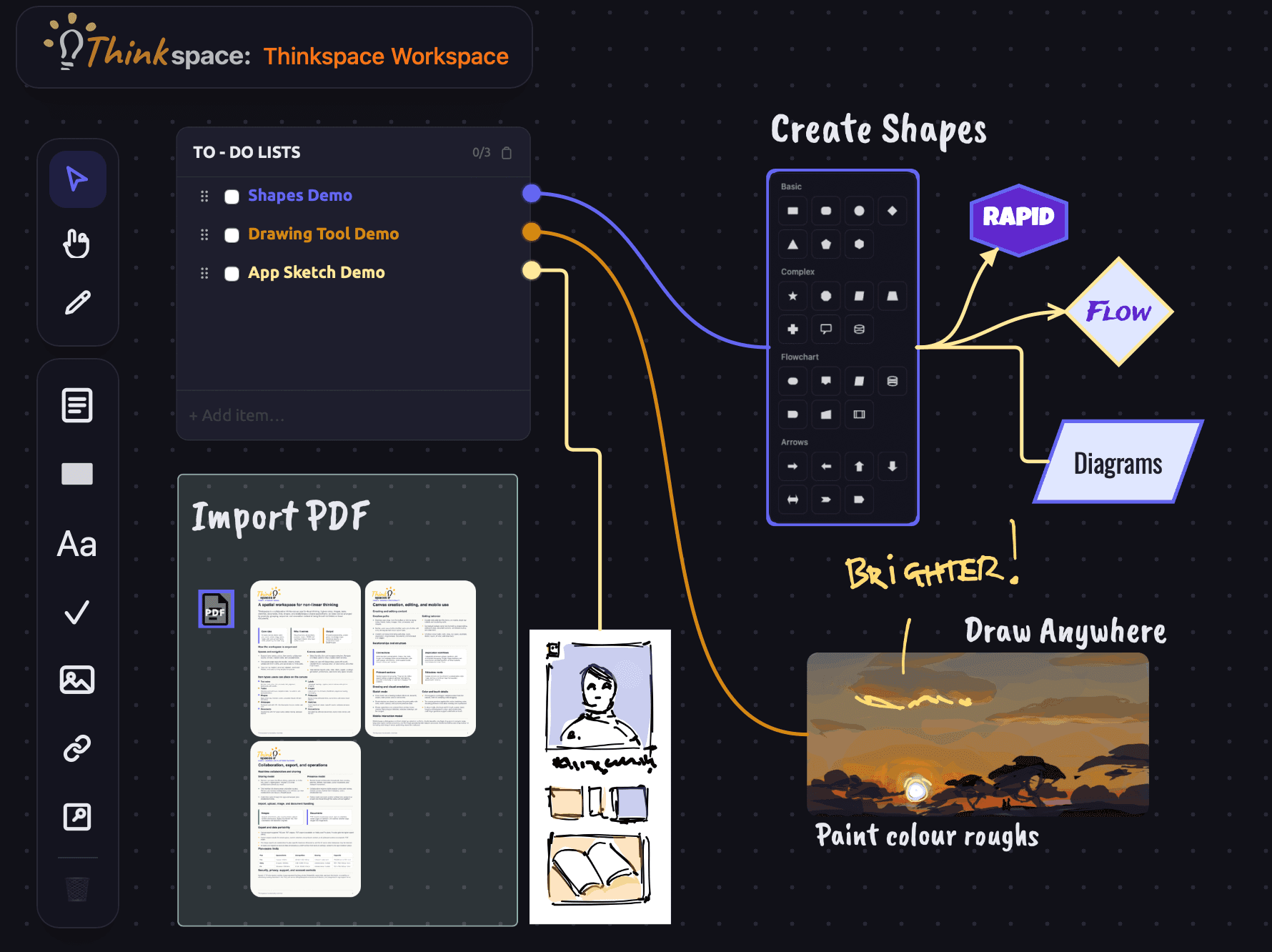
Place notes, images, todos, shapes, and links where they make sense. Thinkspaces helps related thoughts stay near each other instead of disappearing into folders and tabs.
Your ideas don't arrive in order. Thinkspaces is an infinite canvas where notes, sketches and plans sit side by side — arranged the way you think, connected when you're ready.
the problem ↴
Documents demand sequence before you're ready. Folders separate related ideas. Tabs fragment context. But for visual minds, thinking is spatial: we remember position, proximity, grouping, and relationships.
Thinkspaces lets ideas exist in relation to each other, so your workspace can match the shape of your understanding.
why it feels different
Map ideas spatially, connect them as they grow, and collaborate in a way that feels natural to you.
Place notes, images, todos, shapes, and links where they make sense. Thinkspaces helps related thoughts stay near each other instead of disappearing into folders and tabs.
Connect concepts, group clusters, and zoom between details and the bigger picture. The canvas becomes a map of what you understand.
Start messy, follow associations, and let structure emerge. Give your ideas room to breathe. You don't have to force early concepts into a linear document before they're ready.
who it helps ↓
See how concepts connect instead of memorising isolated notes.
Map complexity, sources, questions, and emerging patterns in one navigable space.
Work in the direction your thoughts naturally flow: outward, sideways, and back again.
Turn subjects into spatial knowledge maps that are easier to navigate and remember.
Build shared understanding, not just shared files.
the philosophy
Insight tends to come from unexpected connections, not tidy sequences. Your tools should help you notice patterns, keep the wider context in view, and follow several threads without dropping any of them.